|
|
How a Basic
Fluorescent Lamp Works
By:
Jonathan Z. Kremer
General Design
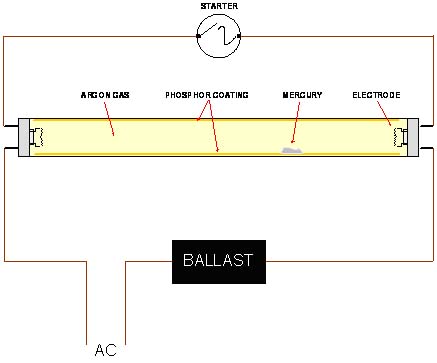
The general design of a simple fluorescent lamp consists of a sealed
glass tube. The tube contains a small bit of mercury and a gas (usually
argon) kept under very low pressure. The tube also contains a phosphor
powder, coated along the inside of the glass. The tube has two
electrodes, one at each end, which are wired to an electrical circuit.
The electrical circuit, which includes a starter and ballast, is hooked
up to an alternating current (AC) supply.
 General Operation:
When the lamp is first turned on, the current travels through the path
of least resistance, which is through the bypass circuit, and across the
starter switch. This current then passes through the circuit heating up the
filament in each electrode, which are located at both ends of the tube
(these electrodes are simple filaments, like those found in incandescent
light bulbs). This boils off electrons from the metal surface, sending them
into the gas tube, ionizing the gas. The mercury vapor becomes "excited" and
it generates radiant energy, mainly in the ultraviolet range. This energy
causes the phosphor coating on the inside of the tube to fluoresce,
converting the ultraviolet into visible light.
The Starter:
The starter is basically a time delay switch. Its job is to let the
current flow through to the electrodes at each end of the tube, causing the
filaments to heat up and create a cloud of electrons inside the tube. The
starter then opens after a second or two. The voltage across the tube allows
a stream of electrons to flow across the tube and ionize the mercury vapor.
Without the starter, a steady stream of electrons is never created
between the two filaments, and the lamp flickers.
The Ballast:
The ballast works mainly as a regulator. They consume, transform, and
control electrical power for various types of electric-discharge lamps,
providing the necessary circuit conditions for starting and operating them.
In a fluorescent lamp, the voltage must be regulated because the current
in the gas discharge causes resistance to decrease in the tube. The AC
voltage will cause the current to climb on its own. If this current isn’t
controlled, it can cause the blow out of various components.
Newer Designs:
Today, the most popular fluorescent lamp design is the “rapid start”
lamp. This design works the same as the basic design described above, but it
doesn't have a starter switch. Instead, the lamp's ballast constantly
channels current through both electrodes. This current flow is configured so
that there is a charge difference between the two electrodes, establishing a
voltage across the tube.
Another method used in instant-start fluorescent lamps, is to apply a
very high initial voltage to the electrodes. This high voltage creates a
corona discharge, which causes an excess of electrons on the electrode
surface that forces some electrons into the gas. These free electrons ionize
the gas, and almost instantly the voltage difference between the electrodes
establishes an electrical arc.
In Conclusion:
There are many different types of fluorescent lamps but they all work in
the same basic way: An electric current stimulates mercury atoms, which
causes them to release ultraviolet photons. These photons in turn stimulate
a phosphor, which emits visible light photons
|


